
FibrePlate™ Fusion Membrane Bioreactor (MBR) Technology
Advanced Immersed MBR System for Long-Term Wastewater Treatment Performance
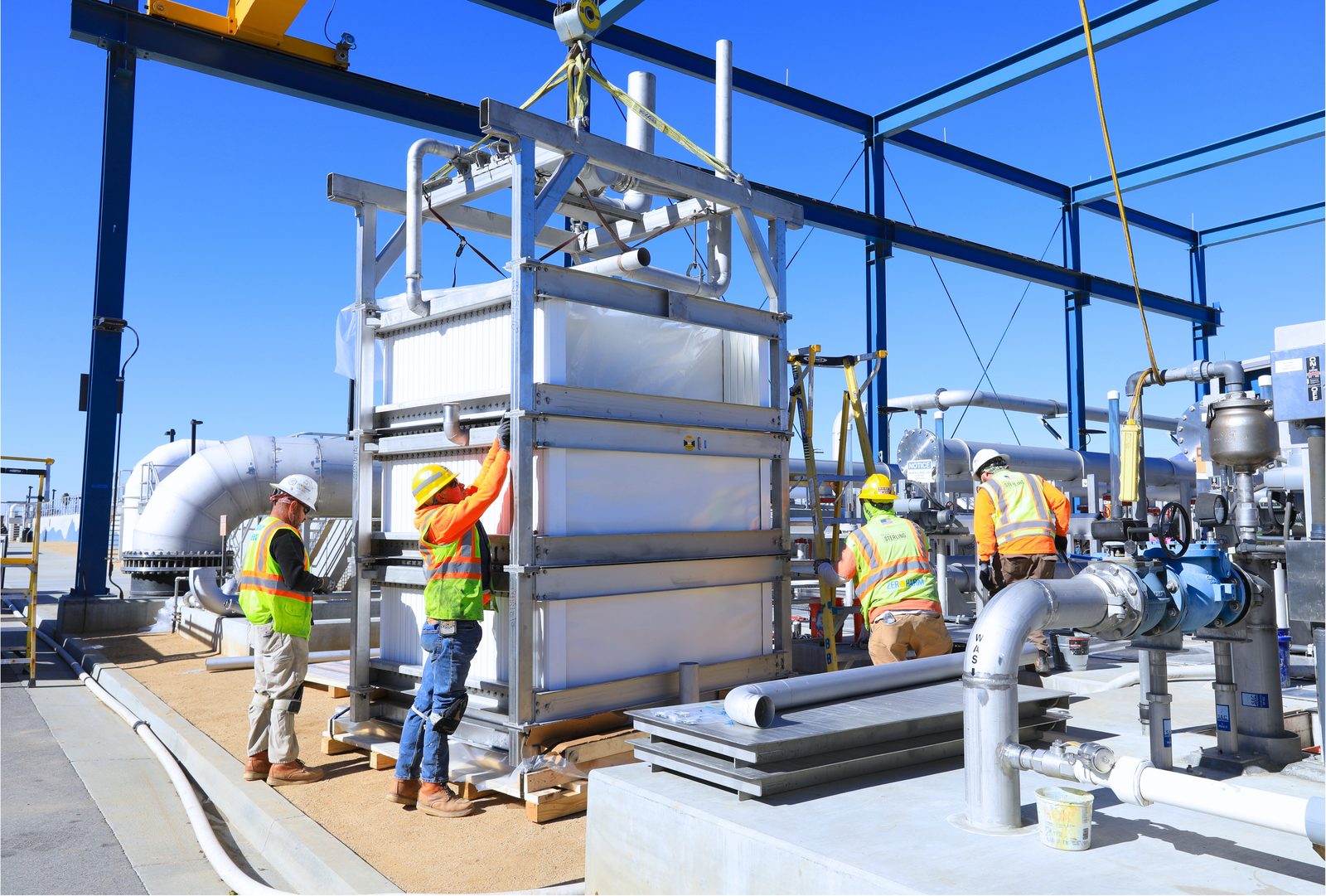
FibrePlate™ Fusion membrane technology represents the structural evolution of immersed Membrane Bioreactor (MBR) architecture. It is engineered for long-term, full-scale wastewater treatment where lifecycle predictability, operational stability, and risk control define system value. Designed for municipal and industrial wastewater treatment plants, FibrePlate™ Fusion functions as a reference architecture for multi-decade infrastructure assets operating under real-world hydraulic and loading variability.
Conventional immersed MBR systems are constrained by structural failure modes that emerge over time, such as hydraulic restriction, fouling instability, escalating aeration demand, and operator-driven intervention. FibrePlate™ Fusion removes these risks at the architectural level, delivering compact system layouts, stable biological performance, and controlled OPEX trajectories rather than short-term performance optimization.
Unlike legacy immersed MBR membranes that rely on dense hollow-fiber bundles or restrictive flat-plate stacks, FibrePlate™ Fusion employs a horizontal hybrid membrane architecture that maintains hydraulic openness over the asset lifecycle. This design prevents debris accumulation, stabilizes transmembrane pressure (TMP), and caps fouling-driven escalation, enabling predictable long-term operation rather than reactive management.
- By eliminating dead zones and restrictive flow paths inherent to legacy immersed MBR systems, FibrePlate™ Fusion controls the primary drivers of long-term degradation and enables:
- Sustainable loading rates without accelerated fouling
- Reduced bioreactor volume and footprint without hydraulic compromise
- Stabilized aeration demand over time
- Controlled chemical cleaning frequency
- Infrastructure-grade operational reliability across decades of service
These outcomes are not incremental benefits. They represent risk removal across capital exposure, operating stability, and lifecycle cost predictability, particularly in facilities subject to variable flows, fluctuating solids loading, and tightening discharge or reuse requirements.
True Ultrafiltration for Municipal, Industrial, and Reuse Applications
FibrePlate™ Fusion membrane technology is built around a hybrid PVDF ultrafiltration membrane with a nominal pore size of 0.04 μm. This delivers true ultrafiltration performance required for infrastructure-grade solids separation, supporting:
- Municipal wastewater treatment
- Industrial wastewater treatment
- Water reuse and advanced treatment applications
This level of separation prevents solids breakthrough, stabilizes biological operation, and removes downstream process risk when integrated into multi-barrier treatment trains for reuse-driven MBR systems.
Platform Characteristics
- Hybrid PVDF ultrafiltration membrane (0.04 μm pore size)
- 500 ft² active filtration area per membrane module
- Stainless steel membrane cassettes configurable from 2 to 84 modules
- Compatible with MBR retrofit projects and greenfield MBR system designs
The modular system architecture supports phased capacity expansion and diverse plant configurations without introducing long-term hydraulic or operational penalties, maintaining lifecycle performance consistency rather than short-term flexibility alone.
Lifecycle Performance and Risk Reduction
FibrePlate™ Fusion is engineered to control the structural variables that drive energy escalation, fouling instability, and OPEX uncertainty in conventional immersed MBR systems. By removing the architectural causes of degradation, FibrePlate™ Fusion shifts membrane bioreactor operation from reactive intervention to predictable lifecycle control across the full service life of the asset.